Pages
720
Year
2026
Level
intermediate to advanced
Read time
18h
Martin Kleppmann, Chris Riccomini · O'Reilly Media · 2026
Reviewed by Ashish Sheth · Updated June 2026
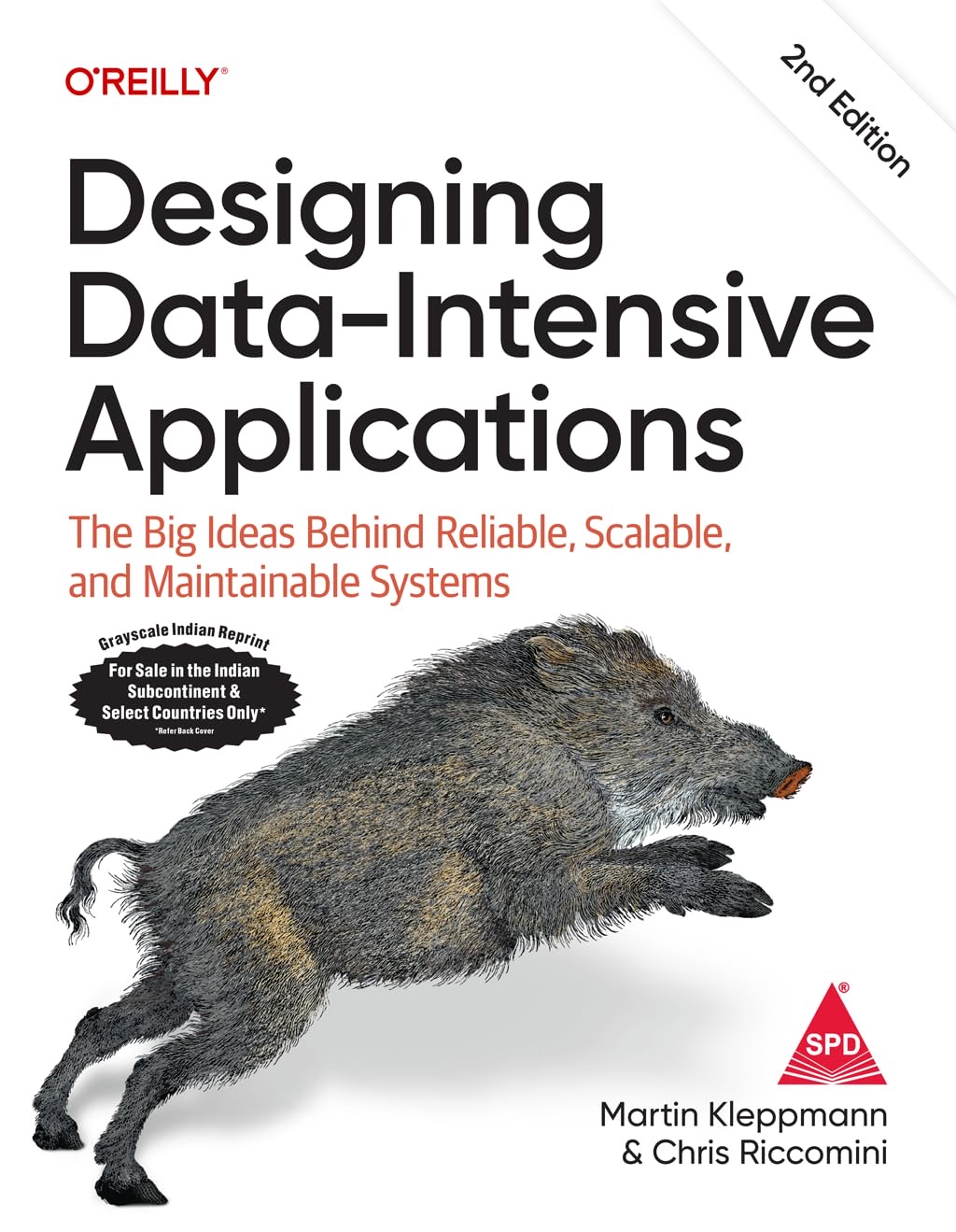
Designing Data-Intensive Applications
The Big Ideas Behind Reliable, Scalable, and Maintainable Systems
4.7 / 5
AMAZON · 312 RATINGS
system design
SUBJECTS
What you'll come away with
01.
How to reason about consistency, availability, and partition tolerance under real failure modes
02.
Why most production data problems are coordination problems, not throughput problems
03.
When to reach for replication vs sharding vs both, and what each costs you
04.
How modern streaming systems generalize batch processing and databases
05.
The trade-offs behind every storage engine choice you'll ever make
06.
How AI/ML data systems (vector indexes, DataFrames, training pipelines) fit the same patterns
Strengths
+Best-in-class explanations of distributed systems fundamentals
+Vendor-neutral: teaches principles, not specific tools
+Excellent diagrams that make consensus and replication finally click
+2nd edition refreshes every chapter and adds AI/ML data systems coverage
Caveats
−Dense: not a weekend read, expect 3-4 months at one chapter per week
−Light on hands-on code; pair with a database internals book for implementation depth
−Some readers wish the new edition went deeper on cloud-native specifics
★ 4.7 FROM 312 READERS ON AMAZON
Check Price on Amazon →
Read this if
→Backend engineers who want to stop guessing at distributed systems behavior
→Anyone preparing for senior or staff-level system design interviews
→Data and platform engineers picking storage and streaming infrastructure
Skip this if
—Frontend-only engineers with no backend ambitions
—People who want a quick interview cram (try a system design interview book)
—Beginners still learning their first database — finish a SQL primer first
Head-to-head comparisons
Designing Data-Intensive Applications vs Software Engineering at Google → Designing Data-Intensive Applications vs The Pragmatic Programmer → Designing Data-Intensive Applications vs A Philosophy of Software Design → Designing Data-Intensive Applications vs Building Microservices → Designing Data-Intensive Applications vs Release It! → Designing Data-Intensive Applications vs Understanding Distributed Systems → Designing Data-Intensive Applications vs Fundamentals of Software Architecture → Designing Data-Intensive Applications vs Fundamentals of Data Engineering → Designing Data-Intensive Applications vs Database Internals → Designing Data-Intensive Applications vs Accelerate → Frequently asked
Is the 2nd edition of Designing Data-Intensive Applications worth buying if I already own the first?
If you read the first edition cover to cover already, the upgrade is incremental: every chapter is refreshed and there's new coverage of AI/ML data systems, cloud-native architectures, and modern streaming. If you skimmed the first or read it years ago, the 2nd edition is the better starting point.
Do I need a CS degree to read Designing Data-Intensive Applications?
No. You need comfort with at least one database (Postgres, MySQL) and one programming language. Kleppmann teaches the theory you need as it comes up — you won't be lost in formal proofs.
Is DDIA still relevant in 2026 with AI and vector databases everywhere?
More relevant, not less. The 2nd edition adds explicit coverage of vector indexes, DataFrames, and training-data pipelines, and the underlying distributed systems fundamentals are exactly what AI infrastructure teams need. Most AI data problems are old distributed systems problems in new packaging.
Read this next
6 alternatives
Ready?
Check Price on Amazon →